🇹🇭
Thailand
The Ultimate Thailand Itinerary — Bangkok, Chiang Mai & Koh Phangan
Duration
10 days
Best Time
Nov–Apr (dry)
Daily Budget
$50–120 USD
Difficulty
Easy
The Ultimate Thailand Itinerary — Bangkok, Chiang Mai & Koh Phangan
This is the best Thailand itinerary for first-time visitors who want to see the country properly in 10 days — Bangkok for street food, temples and Muay Thai; Chiang Mai for elephant sanctuaries, Songkran, and Loy Krathong; and Koh Phangan for the legendary Full Moon Party. It's the classic Bangkok–Chiang Mai–islands route, but built around the experiences that actually make Thailand extraordinary rather than just the tourist checklist.
Whether you're planning an ultimate Thailand itinerary for two weeks, a 10-day Thailand trip, or just trying to figure out the Bangkok to Chiang Mai to Koh Phangan routing — this guide covers every experience, hotel, and transit connection you need.
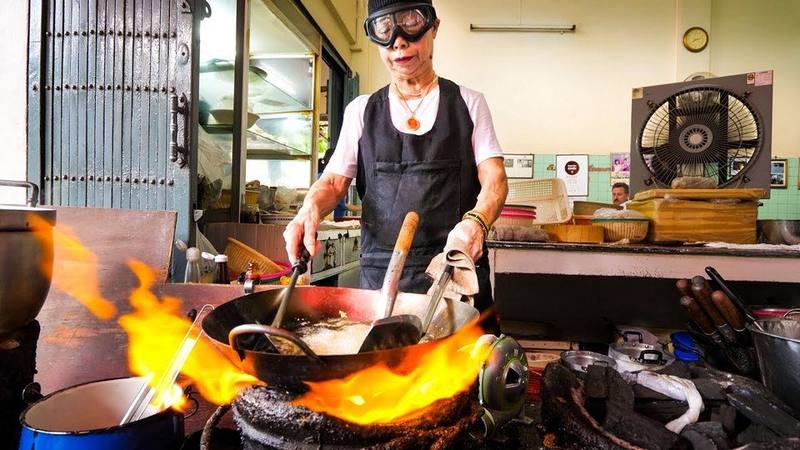
Start with Jay Fai. She's a 70-something woman who cooks alone on Mahachai Road, wearing ski goggles to protect her eyes from the wok smoke she's been breathing for 40 years. In 2017 the Michelin Guide awarded her a full star — the first street food vendor in Thailand to receive one — for her crab omelette: an enormous, crisp-edged, impossibly light thing stuffed with fresh crab meat that costs around $30 and is worth every baht. The queue starts before she opens. Go early, add your name to the list, and wait. It is completely worth it.
Jay Fai is the headline act, but Bangkok has more Michelin-starred street food than any city on Earth. The Michelin Guide Thailand awarded Bib Gourmand recognition to dozens of stalls and shophouses that Western food culture had ignored entirely — pad thai vendors who've been making one dish for 30 years, boat noodle stalls in Chinatown serving bowls at 50 cents, Hainanese chicken rice shops where the broth alone takes eight hours to prepare. The combination of extraordinary technique and negligible cost is unlike anything else in food.
A guided night food tour of Bangkok is one of the best value experiences in travel — for $30–40 you eat at 6–8 different stalls across Chinatown, Silom, and the Old Town, with a guide who knows exactly where to go and when. Chinatown (Yaowarat Road) at 8pm is the most atmospheric: the street gives itself entirely over to cooking, wok-smoke and garlic and fish sauce in the air, and the energy is extraordinary.
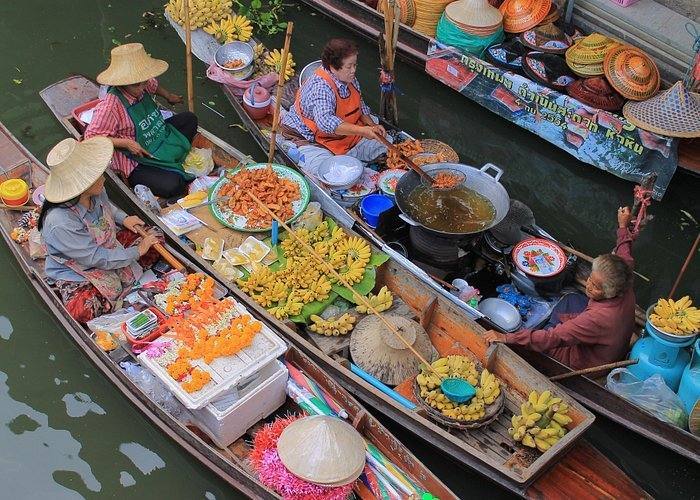
The Damnoen Saduak floating market, 100km southwest of Bangkok, is one of Thailand's most iconic images — narrow wooden canoes piled with tropical fruit, cooked noodles, and grilled corn navigated through a labyrinth of canal waterways by women in traditional dress and wide-brimmed hats. It is real, it is functioning, and it is genuinely spectacular at the right hour.
Go as early as possible. The market is busiest between 8am and 10am but the most atmospheric hour is 6–7am when vendors are setting up, the mist is still on the water, and the canals carry mostly Thai buyers rather than tourists. Hire a long-tail boat from the main pier to access the deeper canals where the wholesale activity happens — away from the souvenir stalls at the main entrance.
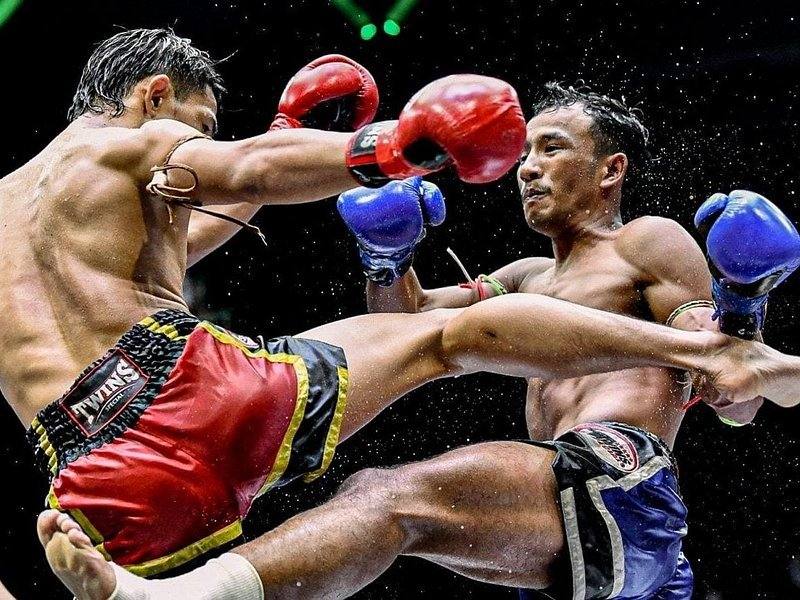
Muay Thai — the art of eight limbs — is Thailand's national sport and one of the most effective striking martial arts in the world. Fighters use fists, elbows, knees, and shins — eight striking surfaces versus boxing's two — in bouts that combine explosive power with genuine tactical sophistication. Watching it live is one of the finest sports experiences in Southeast Asia.
The atmosphere at a live fight bears no resemblance to watching it on a screen. The sarama music — traditional Thai fight music played throughout by a live band — creates a hypnotic undercurrent to the action. The crowd bets actively through hand signals; the energy peaks and ebbs with the fight's momentum. Lumpinee Stadium in Bangkok is the spiritual home; Rajadamnern is the historic alternative.
Taking a Muay Thai lesson is equally worthwhile — Bangkok and Chiang Mai have serious training camps that offer single sessions for beginners. Two hours learning the basic stance, guard, and strikes from a genuine fighter produces a physical and educational experience unlike any gym class.
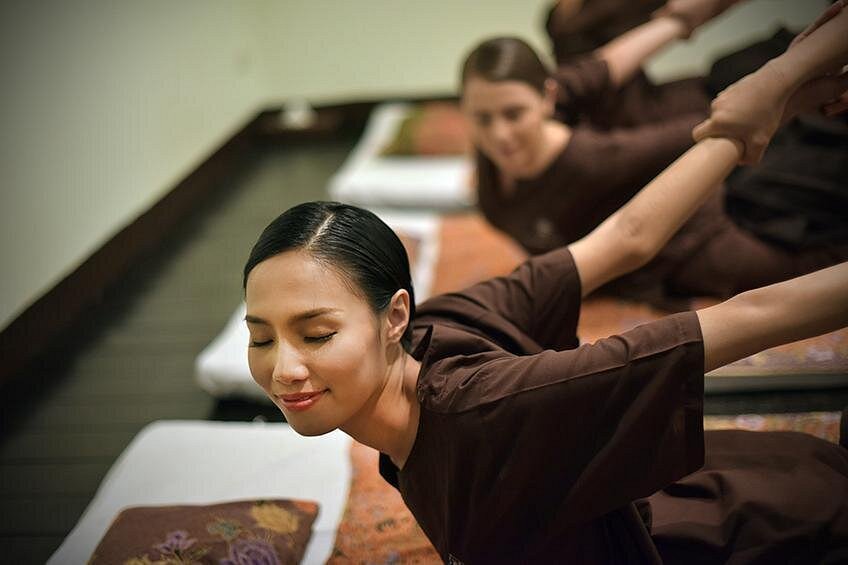
Traditional Thai massage is not a relaxation massage. It is an ancient therapeutic practice rooted in Ayurvedic medicine and Buddhist healing traditions — a 2,500-year-old system of assisted stretching, acupressure, and energy line work that treats the body as a connected system rather than a collection of muscles to be kneaded. A skilled practitioner works your entire body through a sequence of positions that would require two people and a yoga mat to replicate independently.
Quality varies enormously. In tourist areas, many massage shops offer Thai massage at 200–300 baht per hour — these are fine for basic relaxation. For genuine therapeutic Thai massage, seek out schools and clinics trained at Wat Pho (Bangkok) or the Old Medicine Hospital (Chiang Mai) — the two most respected training institutions. A 2-hour session with a qualified therapist from either institution costs 400–600 baht and produces results that the tourist-strip massage simply doesn't.
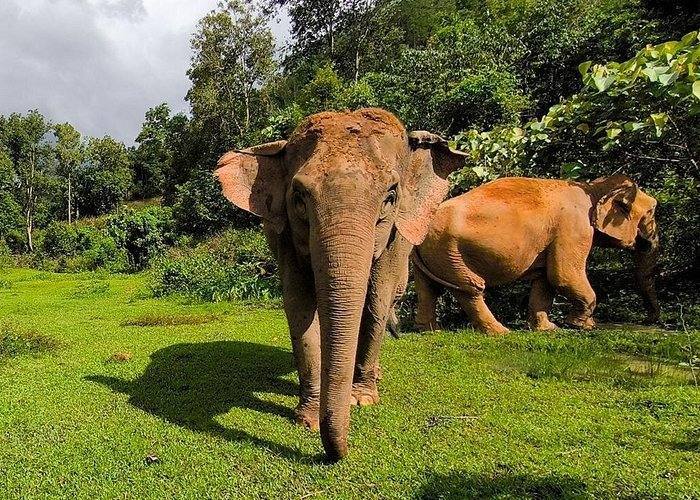
Thailand has a long and complicated history with elephants — the animals are culturally central (the white elephant is a national symbol) but the elephant tourism industry has historically involved severe mistreatment. The shift toward ethical sanctuaries — where rescued elephants live in large forest enclosures, are not ridden, not forced to perform, and interact with visitors on their own terms — represents the right direction, and the experience at a genuine sanctuary is significantly more moving than any riding experience.
A half-day at a genuine ethical sanctuary involves walking with the elephants through forest, feeding them fruit, watching them interact with each other in the social hierarchies that are the core of elephant life, and occasionally the elephants deciding to investigate you in return. The mud bath section — where you help cover a willing elephant in protective mud — is reliably joyful for both parties.
The key distinction: no riding. Any sanctuary that offers elephant rides is not operating ethically. Reputable options near Chiang Mai include Elephant Nature Park (the most established), Elephant Jungle Sanctuary, and GTEF — all have genuine rehabilitation programmes.
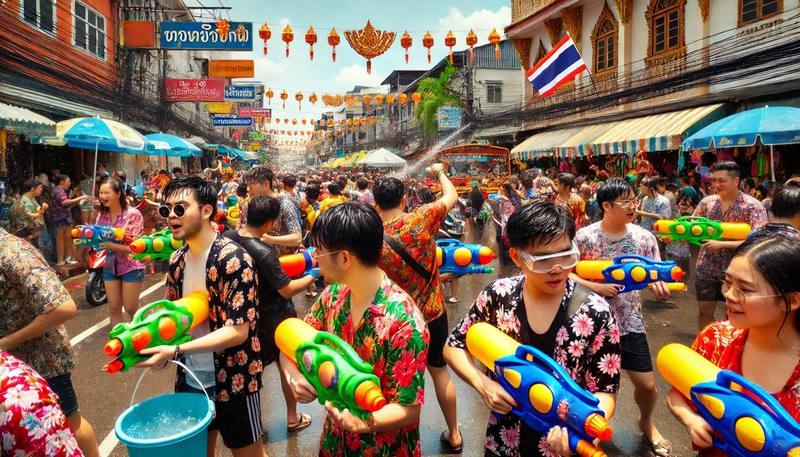
Songkran is Thailand's traditional New Year — and it is also the world's largest, most joyful, most completely uninhibited water fight. For three days (April 13–15, extending to 5–7 days in Chiang Mai), the entire country essentially stops and throws water at each other. Buckets, hoses, water guns, garden hoses attached to pickup trucks — everything is in play. Nobody is exempt. Monks watch from doorways. Elderly grandmothers ambush tourists with ice-cold buckets. Children stationed at street corners score direct hits on motorcycles passing at 30km/h. It is magnificent.
Chiang Mai's moat road around the old city becomes the focal point — a continuous 10km circuit where locals and tourists mix in equal measure and the water never stops. The spirit is genuinely inclusive and good-natured; Songkran has none of the edge of nightclub festivals. Families participate, strangers share supplies, and the Buddhist tradition of water blessings underpins the whole thing with a sense of renewal rather than pure chaos.
Protect your electronics — waterproof cases are essential and available everywhere for a few dollars. Wear clothes you don't mind ruining. Sunscreen constantly. Book accommodation in Chiang Mai months in advance; the city fills completely for Songkran.
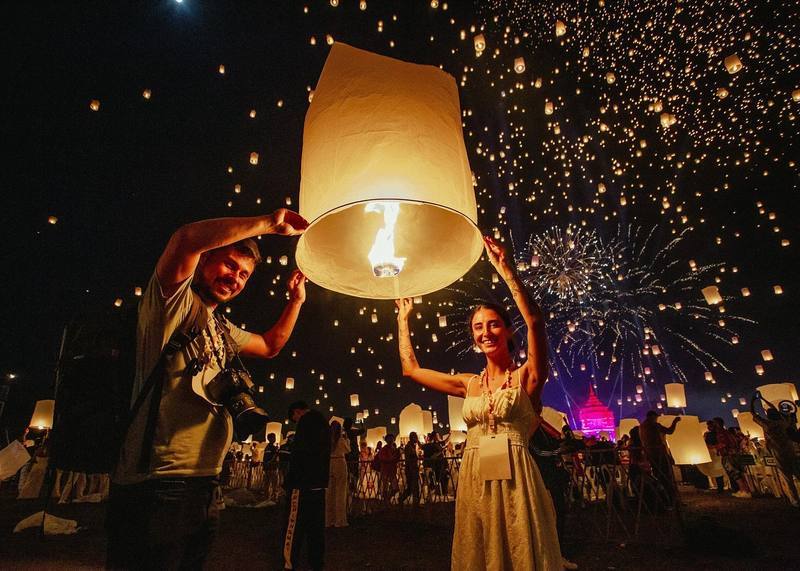
On the full moon night of the 12th lunar month — usually November — Chiang Mai releases ten thousand paper lanterns into the sky simultaneously. The Yi Peng sky lantern festival, held alongside the water-based Loy Krathong, produces one of the most photographed and most genuinely extraordinary visual experiences available anywhere in the world: a dark sky filling with slowly rising points of orange light until it resembles an upside-down galaxy, each lantern carrying a wish or a prayer from the person who lit it.
The lanterns are made of tissue paper over a bamboo frame with a wax fuel disc at the base — lit from below, they fill with hot air and rise in a few minutes, drifting upward on the warm night air. The coordinated mass releases at the formal event venues are the most spectacular; the informal releases along the Ping River throughout the evening are more intimate.
Alongside the sky lanterns, Loy Krathong involves floating krathong — small lotus-shaped vessels made from banana leaves, flowers, and candles — on the river as offerings. The combination of fire above and water below, in a city that takes both very seriously, makes this the most visually extraordinary festival in Southeast Asia.
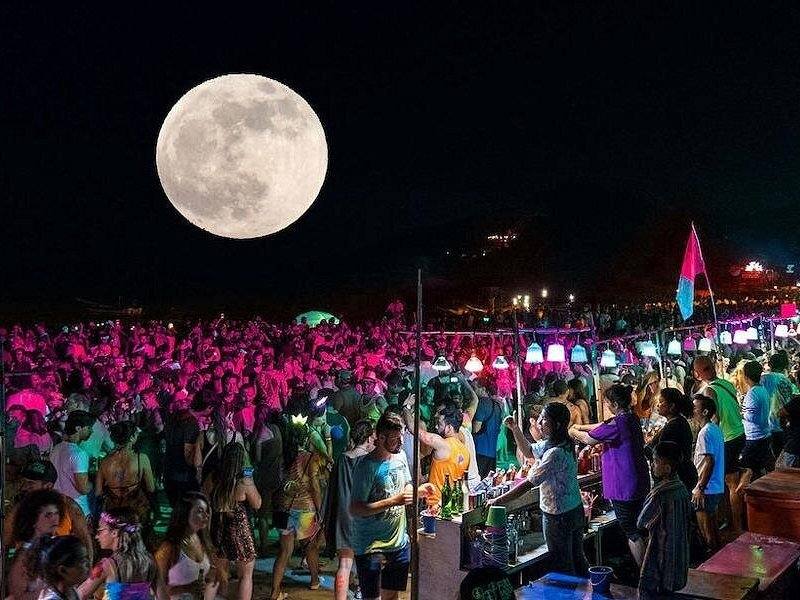
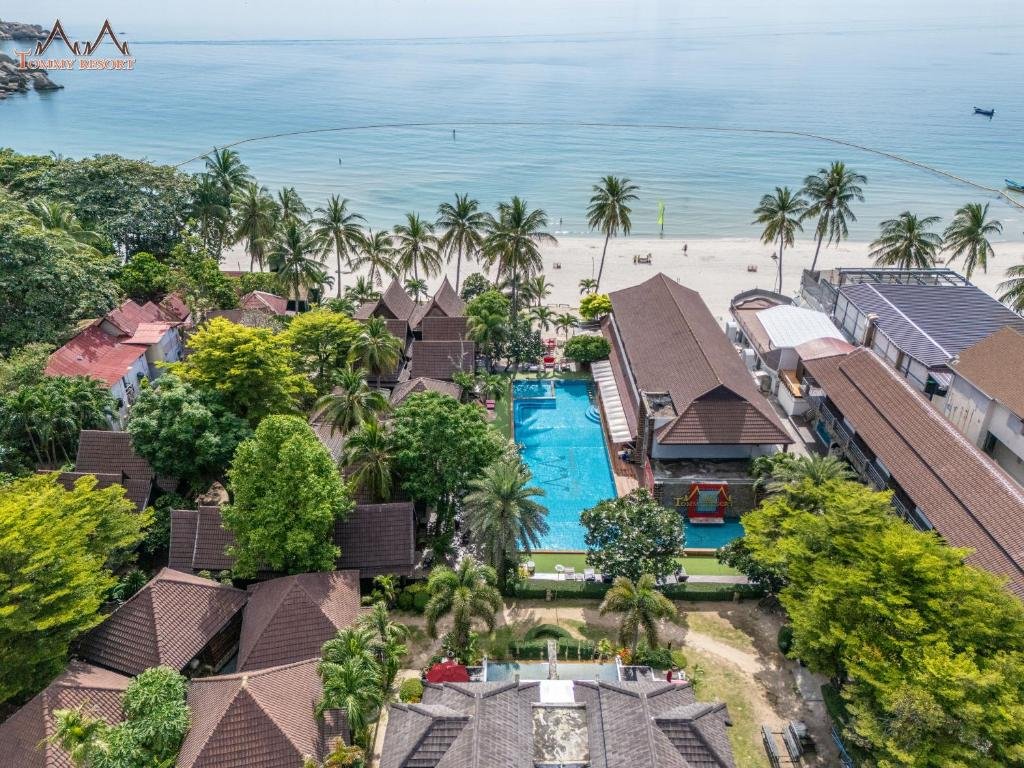
The Full Moon Party at Haad Rin Beach on Koh Phangan has been running every month since the 1980s and remains one of the most famous parties in the world — 20,000–30,000 people on a beach on the south tip of a jungle island, multiple sound systems, fire shows, and the full moon overhead. It is exactly as chaotic, beautiful, and fun as described.
The party starts genuinely around 9pm and peaks between midnight and 3am. The fire shows — performers spinning fire staffs, fire jump ropes, flaming hoops — are the visual centrepiece and happen continuously along the beach throughout the night. The music is relentlessly loud and ranges from techno to reggae to commercial pop depending on which section of beach you're standing on.
Practical realities: wear shoes you don't mind destroying (the beach has broken glass from drink buckets), keep your valuables somewhere very secure, and book accommodation months in advance — Koh Phangan fills completely on full moon weekends.